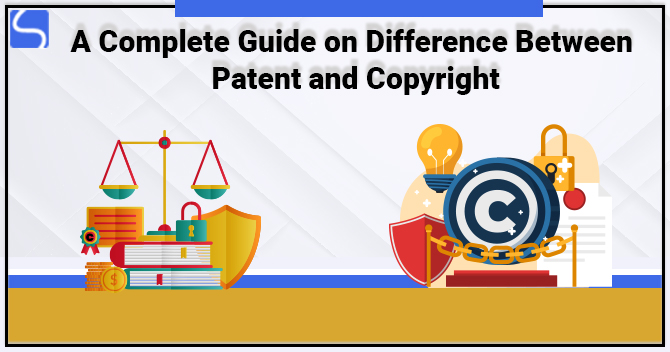
A Complete Guide on Difference Between Patent and Copyright

Karan Singh | Updated: Mar 15, 2021 | Category: Copyright, Patent
Patent and Copyright are two different types of Intellectual Property (IP), and people get confused and have many doubts regarding Patents and Copyrights. Although these Intellectual Properties forms several apparent similarities, they are unique in nature and aid various purposes. Scroll down to check the difference between Patent and Copyright.
Table of Contents
What is a Patent? – An Overview
Before we discuss the difference between Patent and Copyright, let us first understand the term Patent and Copyright. The primary purpose of the Patent law is to boost innovation and commercialization of technological advances. Patent law encourages inventors to reveal their inventions in exchange for some exclusive rights publicly. These inventions can comprise new & useful processes, manufactures, machines, etc. Some computer programs may come under the subject matter safeguarded by both Copyright and Patent. In this case, the Patent compliments copyright protection by providing protection for the software’s practical aspects, which are not safeguarded by Copyright. Unlike Copyright protection, to get Patent security, one should apply for Patent Registration and be granted a patent from the USPTO or the United States Patent and Trademark Office. Unlike the process of Copyright Registration, the process of Patent Registration is costly, complicated, and time-consuming.
Patent represent legal articles, and it could be hard to obtain. The applicant has to wait for a year for approval for the application of Patent Registration. The most challenging phase of Patent Registration is the inspection phase, in which the examiner conducts an in-depth inspection or examination of the invention on the fixed grounds. The inspector continuously tests the sample until they get satisfied and finds that the invention fulfils all requirements and makes sure that it does not look similar to the earlier invention. The inspection will take a couple of months, and sometimes it will take a year, depending on the difficulty of the invention. Once your invention gets eligible for the Patent, you can protect the right to use the invention on your terms. In simple terms, the Patent sets an exclusive right for the inventor, which renders their complete authority over its invention.
What is Copyright? – An Overview
Copyright is an exclusive right that protects your original work from infringement. Moreover, Copyright protects the form of expression, not the idea behind it. The creator who owns the Copyright Registration has a special right to distribute, republish, and recreate their work without restrictions. Copyright is only valid to the work which follows the noticeable form of expression. As soon as the creator finishes the creation, the impression of Copyright comes into existence.
As the owner of Copyright, you have the power to transfer Copyright individually to one or more people or transfer collectively to one or more people. This can be done by assigning, licensing and various forms of transfers. Copyright power allows you to choose the way your work is made available to the general public. Moreover, to reveal the creation publicly, the patented invention or creation is unique and advocates freshness and uniqueness. It extracts revolutionary solutions to a problem that has been persevered for ages.
What is the Key Difference between Patent and Copyright?
You can check the difference between Patent and Copyright from the table mentioned below:
| Copyright | Patent |
| A Copyright is governed under the Copyright Act, 1957. | A Patent is governed under the Patent Act, 1970. |
| It safeguards an original creative expression such as dramatic works, cinematography firms, literary works, dramatic works, sound recordings, etc. | It safeguards inventions that are original, unique and has industrial utility. |
| The valid of a Copyright is for the lifetime of the author, i.e. 60+ years after his or her death. Protection is available in most of the nations in the world. | The validity of a Patent is for 20 years from the date of the application is made. It is also a territorial right, and thus, it is effective within the boundaries of India only. Separate Patents required for each country where protection is required. |
| It secures intellectual or creative inventions. | It secures inventions that are useful for the world and has some use. For example, a new invention in the Pharmaceutical Industry. |
| No provision application is required for Copyright Registration. | For Patent Registration, a provisional application gets you twelve months of time to file a complete specification and a priority claim date. |
| Creators can apply for Copyright Registration anytime. | Whereas a Patent for an invention cannot be attained once it reveals the invention to the general public or made available in the marketplace. |
| Right to distribute the work, public performance, reproduce, making of derivative works, and display of the copyrighted works. | Right to use the mark and prevent it from others using similar marks in a way that would create confusion about the origin of the goods or services. |
Important Points to Remember on Patent and Copyright
After knowing the primary difference between Patent and Copyright, you must know some vital point regarding Patent and Copyright:
- Copyright serves authors or creators, whereas Patent focuses on inventors;
- Copyright highlights music, art, film, and photography. Whereas the Patent is applied to medical devices and technologies;
- Companies usually adopt Copyright to protect their creative or intellectual works;
- Depending on the work, Copyright Registration renders the time limit from 70 to 170 years. In contrast, the Patent lasts for 15 to 20 years.
Conclusion
Copyright and Patent are separate aspects of Intellectual Property Rights (IPR). Usually, they render protection that holds unique value and has a significant impact on the outside world. A Patent protects the inventions, whereas Copyright is limited to artistic work. So before getting into it, you must know the basic difference between Patent and Copyright because it will help you at the time of registration.
Also, Read: Everything You Must Know About Patent Law in India